Experimental Demonstration of Event-based Optical Camera Communication in Long-Range Outdoor Environment
A research paper proposing a robust demodulation scheme for OCC using event-based vision sensors, achieving record-setting BER < 10^-3 at 200m-60kbps and 400m-30kbps in outdoor experiments.
Home »
Documentation »
Experimental Demonstration of Event-based Optical Camera Communication in Long-Range Outdoor Environment
1. Introduction & Overview
This paper presents a groundbreaking advancement in Optical Camera Communication (OCC) by leveraging Event-based Vision Sensors (EVS) for long-range, high-data-rate outdoor communication. The core contribution is a novel, robust demodulation scheme that combines On-Off Keying (OOK) with toggle demodulation and a Digital Phase-Locked Loop (DPLL). This system addresses key limitations of conventional frame-based OCC, such as throughput constraints tied to camera frame rates and high computational overhead. The proposed method demonstrates record-setting performance, achieving a Bit Error Rate (BER) of less than $10^{-3}$ at distances of 200 meters (60 kbps) and 400 meters (30 kbps) in outdoor environments, marking a significant leap in the practical deployment of OCC technology.
2. Core Insight & Analyst's Perspective
Core Insight: The paper's fundamental breakthrough isn't just about pushing distance or data rate; it's a masterclass in pragmatic system integration. Instead of chasing exotic modulation schemes, the authors cleverly repurpose standard OOK, making it robust for the noisy, asynchronous world of event-based sensing. The real genius lies in the receiver-side Digital Phase-Locked Loop (DPLL), which acts as a "temporal shock absorber," compensating for the inevitable jitter introduced by using low-cost, off-the-shelf microcontrollers (like Arduino) in the transmitter. This approach prioritizes system-level resilience and cost-effectiveness over theoretical purity—a crucial mindset for real-world adoption.
Logical Flow: The argument is elegantly constructed: 1) Frame-based OCC hits a wall (bandwidth, processing). 2) Event-based sensors offer a paradigm shift (asynchronous, sparse data). 3) But raw EVS output is messy for communication. 4) Therefore, optimize the sensor's frequency response and add a DPLL for timing recovery. 5) Result: unprecedented outdoor performance. This flow mirrors successful innovations in other fields, like the way CycleGAN addressed unpaired image translation by introducing a cycle-consistency loss—a simple, elegant constraint that solved a complex problem.
Strengths & Flaws:
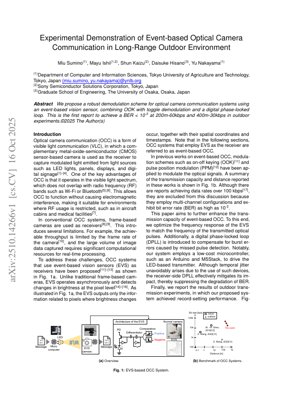
Strengths: The outdoor validation is its killer feature. Most prior work, as noted in the IEEE and ACM digital libraries, remains confined to lab settings. The use of low-cost hardware demonstrates impressive engineering and scalability potential. The benchmark comparison (Fig. 1b in the PDF) is compelling and clearly visualizes the performance leap.
Flaws: The paper is light on analyzing multi-path interference and ambient light flicker (e.g., from sunlight or fluorescent lamps), which are dominant noise sources in real outdoor/indoor scenarios. The BER target of $10^{-3}$ is good for demonstration but falls short of the $10^{-6}$ to $10^{-9}$ required for reliable data services. The system's performance under mobility or with multiple transmitters remains an open question.
Actionable Insights: For researchers: Focus on channel modeling for event-based OCC and explore forward error correction codes tailored for burst errors from missed events. For industry (e.g., Sony, a contributor): This work directly enables applications in secure, localized data broadcast from digital signage or IoT beacons in RF-sensitive areas. The next step is to miniaturize the receiver into a smartphone-compatible module, a challenge akin to integrating LiDAR sensors into mobile devices—difficult but transformative.
3. System Architecture & Proposed Method
The proposed system architecture consists of a transmitter driven by a low-cost microcontroller (e.g., Arduino, M5Stack) modulating an LED, and a receiver based on an Event-based Vision Sensor (EVS).
Unlike frame-based cameras, EVS operates asynchronously, outputting an event stream only when a pixel detects a logarithmic brightness change exceeding a set threshold. Each event contains spatial coordinates $(x, y)$, a timestamp $t$, and a polarity $p$ (ON or OFF). Key tunable parameters per pixel include:
Filter bandwidth (low-pass/high-pass) to shape temporal response.
Refractory period to prevent noise.
Contrast sensitivity threshold.
The authors optimized these parameters to match the frequency of the transmitted optical pulses, enhancing signal detection.
3.2 Proposed Robust Demodulation Scheme
The demodulation scheme is a hybrid approach:
OOK with Toggle Demodulation: Data is encoded using On-Off Keying. The receiver uses a toggle mechanism on the event stream to decode bits, making it robust to baseline brightness fluctuations.
Digital Phase-Locked Loop (DPLL): This core innovation synchronizes the receiver's sampling clock with the incoming event stream. It compensates for timing jitter from the low-cost transmitter and burst errors from missed event detections, significantly improving BER. The DPLL adjusts its phase $\phi$ based on the error between expected and actual event arrival times.
4. Technical Details & Mathematical Formulation
The EVS pixel output can be modeled as a stream of events $E_i = \{x_i, y_i, t_i, p_i\}$. For a transmitted OOK signal $s(t) \in \{0, 1\}$, the probability of an event generation is related to the temporal derivative of the log intensity. The DPLL operation can be simplified as a discrete-time update equation:
where $\phi[n]$ is the phase estimate at step $n$, $e[n]$ is the phase error (difference between detected event timing and the DPLL's internal clock), and $K_p$, $K_i$ are proportional and integral gain constants, respectively. This allows the receiver to "lock onto" the transmitter's clock despite jitter.
5. Experimental Results & Performance
5.1 Experimental Setup
Outdoor experiments were conducted with a transmitter (LED driven by microcontroller) and an EVS receiver. Distances of 200m and 400m were tested. The system used commercially available, low-cost components to emphasize practicality.
5.2 Results and Benchmark
Key Performance Metrics
200m Distance: Achieved 60 kbps with BER < $10^{-3}$.
400m Distance: Achieved 30 kbps with BER < $10^{-3}$.
Comparison: As shown in the benchmark figure (Fig. 1b of the PDF), this work significantly outperforms previous indoor and outdoor event-based OCC systems in the combined metric of distance and data rate. Prior works like Wang 2022 and Shen 2018 are clustered at shorter ranges or lower speeds.
The results conclusively demonstrate that the proposed DPLL-based demodulation effectively mitigates timing jitter, enabling reliable communication at unprecedented ranges for OCC.
6. Analysis Framework & Case Example
Framework: The Resilience-First Communication Stack
This paper implicitly proposes a design framework where resilience to hardware imperfection is a first-class citizen. A case example for analyzing a new OCC proposal would be:
Hardware Abstraction Layer Analysis: What are the inherent noise/jitter characteristics of the chosen transmitter/receiver? (e.g., MCU jitter, sensor latency).
Resilience Mechanism: What algorithmic component (e.g., DPLL, specific coding) is introduced to absorb those imperfections?
Channel Realism: Is testing done in a realistic channel (outdoor light, mobility) or a controlled lab? What are the dominant noise sources addressed?
Performance Trade-off Triangle: Plot the system on a triangle of Data Rate, Distance, and Bit Error Rate. This work pushes the boundary of the Rate-Distance edge while maintaining a practical BER.
Applying this framework to this paper highlights its strength in steps 1 & 2 (addressing MCU jitter with DPLL) and step 3 (outdoor testing), justifying its performance leap.
7. Future Applications & Research Directions
Applications:
Secure Location-Based Services: Broadcasting encrypted keys or data from streetlights, signage, or museum exhibits to specific smartphones without RF interference.
Industrial IoT in RF-Sensitive Zones: Communication in oil refineries, medical MRI rooms, or aircraft cabins.
Vehicle-to-Infrastructure (V2I): Supplementing RF-based communication with high-directionality light links from traffic lights to autonomous vehicles.
Underwater Communication: Blue/green LEDs and cameras can adapt this technology for short-range underwater data links.
Research Directions:
Integration of advanced channel coding (e.g., LDPC, Polar codes) to achieve near-error-free performance ($BER < 10^{-6}$).
Development of Multi-Input Multi-Output (MIMO) techniques using EVS arrays for spatial multiplexing and increased capacity.
Dynamic parameter tuning for EVS pixels to adapt to changing ambient light conditions in real-time.
Standardization efforts, potentially through bodies like IEEE or the Visible Light Communication Association, to ensure interoperability.
8. References
Z. Wang et al., "Event-based High-Speed Optical Camera Communication," in IEEE Transactions on Communications, 2022.
W.-H. Shen et al., "High-Speed Optical Camera Communication Using an Event-Based Sensor," in Proc. OFC, 2018.
J. Geng, "Structured-light 3D surface imaging: a tutorial," Optics and Lasers in Engineering, 2011. (Example of advanced optical sensing)
P. Lichtsteiner et al., "A 128×128 120 dB 15 μs Latency Asynchronous Temporal Contrast Vision Sensor," IEEE Journal of Solid-State Circuits, 2008. (Seminal EVS paper)
IEEE Xplore Digital Library. Search: "Optical Camera Communication".
ACM Digital Library. Search: "Event-based Vision Communication".
Zhu, J.Y., Park, T., Isola, P., & Efros, A.A. (2017). Unpaired Image-to-Image Translation using Cycle-Consistent Adversarial Networks. ICCV. (Cited for analogous problem-solving methodology).