1. Introduction & Overview
This research investigates a critical bottleneck in modern industrial automation: effective communication in human-robot shared workspaces. While collaborative robots (cobots) have broken physical barriers, a cognitive and communicative gap remains. The study posits that nonverbal cues—specifically color-coded LED signals on the robot's end-effector and animated emotional displays on a tablet—can bridge this gap, enhancing safety and workflow efficiency.
The core hypothesis was that combining functional intent signals (LEDs) with socio-emotional cues (facial expressions) would outperform LEDs alone in measures of collision anticipation, communication clarity, and user perception.
2. Methodology & Experimental Design
A within-subjects design was employed to rigorously test the communication modalities.
2.1 Robot Platform & Modifications
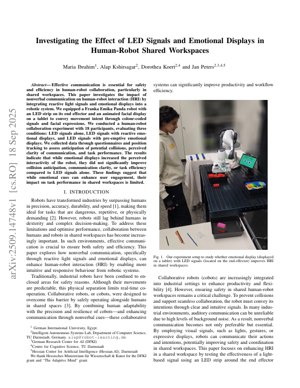
The testbed was a Franka Emika Panda robotic arm. Two key modifications were made:
- LED Strip: Mounted on the end-effector. Colors signaled intent: Green for safe/stationary, Amber for caution/slow movement, Red for stop/collision risk.
- Emotional Display: A tablet mounted near the robot base showed an animated face. Expressions ranged from neutral to surprised/concerned, triggered by proximity to the human worker.
2.2 Experimental Conditions
Three distinct communication conditions were tested:
- Condition A (LED-Only): Basic color-coded light signals.
- Condition B (LED + Reactive Emotional Display): LED signals plus facial expressions triggered in reaction to imminent collision risk.
- Condition C (LED + Pre-emptive Emotional Display): LED signals plus facial expressions that appeared before a potential collision, signaling predictive intent.
2.3 Participant & Data Collection
N=18 participants performed a collaborative assembly task with the robot. Data was triangulated from:
- Objective Metrics: Position tracking (reaction time, minimum distance to robot).
- Subjective Metrics: Post-task questionnaires (NASA-TLX for workload, custom scales for perceived safety, communication clarity, and robot interactivity).
3. Results & Analysis
The findings revealed a nuanced and somewhat counter-intuitive picture.
3.1 Collision Anticipation Performance
Key Result: No statistically significant difference was found in collision anticipation time or minimum avoidance distance across the three conditions. The simple LED signal was as effective as the more complex emotional displays in enabling humans to avoid the robot.
Chart Implication: A bar chart of "Mean Reaction Time (ms)" would likely show three bars (for Conditions A, B, C) with overlapping error bars, indicating no practical difference.
3.2 Perceived Clarity & Interactivity
Diverging Result: While objective performance was similar, subjective perceptions differed. Questionnaire data indicated that conditions with emotional displays (B & C) were rated significantly higher in perceived robot interactivity and social presence.
Chart Implication: A line graph of "Perceived Interactivity Score" would show a clear upward trend from Condition A (lowest) to Condition C (highest).
3.3 Task Efficiency Metrics
Key Result: Task completion time and error rate did not improve with the addition of emotional displays. The LED-only condition provided sufficient information for efficient task execution without the potential cognitive load of processing an additional emotional cue.
Core Performance Finding
No Significant Improvement
Emotional displays did not enhance objective safety (collision anticipation) or task efficiency metrics compared to LED signals alone.
Core Perception Finding
Increased Perceived Interactivity
Conditions with emotional displays were rated higher for robot interactivity and social presence, despite no performance gain.
4. Technical Implementation Details
The system's logic can be formalized. The robot's state and the human's position $p_h$ are monitored. A risk field $R(d)$ is computed based on the distance $d = ||p_r - p_h||$ between robot and human.
The LED signal $L$ is a direct function of $R(d)$:
$L = \begin{cases} \text{Green} & R(d) < \tau_{safe} \\ \text{Amber} & \tau_{safe} \leq R(d) < \tau_{warning} \\ \text{Red} & R(d) \geq \tau_{warning} \end{cases}$
Where $\tau_{safe}$ and $\tau_{warning}$ are empirically determined thresholds. The emotional display $E$ in the reactive condition (B) was triggered when $R(d) \geq \tau_{warning}$. In the pre-emptive condition (C), it was triggered based on a predictive model of human motion, attempting to signal intent before $R(d)$ reached the warning threshold.
5. Critical Analysis & Expert Interpretation
Core Insight: This paper delivers a crucial, sobering reality check for HRI designers enamored with anthropomorphism. Its central finding—that "emotional displays increased perceived interactivity but did not improve functional performance"—is a watershed moment. It forces a strategic bifurcation: are we designing for user engagement or for operational throughput? In high-stakes, efficiency-driven shared workspaces, this study suggests that elaborate social cues might be mere "cobot cosmetics," adding cognitive overhead without ROI on safety or speed. The LED strip, a simple, low-cost, and unambiguous signal, emerges as the unsung hero.
Logical Flow & Strengths: The experimental design is robust. The within-subjects approach controls for individual differences, and the tripartite condition structure (LED-only, reactive, pre-emptive) elegantly isolates the variable of emotional cue timing. The use of both objective (motion tracking) and subjective (questionnaire) metrics is a gold standard, revealing the critical divergence between what people feel and what they do. This aligns with findings in other domains of human-machine interaction, such as the research from the MIT Media Lab on "calm technology," which advocates for information design that resides in the periphery of attention until needed.
Flaws & Missed Opportunities: The study's primary weakness is its scale (N=18) and likely homogeneous participant pool (academic setting), limiting generalizability to diverse industrial workers. Furthermore, the "emotional display" was a 2D cartoon on a tablet—a far cry from the integrated, nuanced expressions studied in advanced social robotics platforms like Boston Dynamics' Spot or SoftBank's Pepper. Would a more physically embodied or sophisticated expression have changed the outcome? The study also doesn't explore long-term effects; the novelty of an emotional display might wear off, or its utility might increase with familiarity, a phenomenon observed in longitudinal HRI studies.
Actionable Insights: For industry practitioners, the mandate is clear: Prioritize clarity over charisma. Invest first in rock-solid, intuitive functional signaling (like well-designed LED states) that directly maps to robot action states. Only after that foundation is laid should you consider adding emotional layers, and only with a clear hypothesis about their specific utility—perhaps for reducing long-term fatigue, improving trust in complex tasks, or aiding training. This research echoes the principle from the seminal work on "The Media Equation" (Reeves & Nass)—that people treat media socially—but adds a crucial industrial caveat: social treatment doesn't always translate to functional improvement when the task is procedural and goal-oriented.
6. Analysis Framework & Case Example
Framework: The "Functional-Social Communication Matrix"
This study inspires a simple 2x2 framework to evaluate HRI communication modalities:
| High Functional Utility | Low Functional Utility | |
|---|---|---|
| High Social Engagement | Ideal e.g., A gesture that both signals direction and feels natural. | Distracting Ornament e.g., The emotional display in this study—liked but not helpful for the task. |
| Low Social Engagement | Efficient Tool e.g., The LED-only signal—clear, effective, but "cold." | Ineffective e.g., A subtle sound cue in a noisy factory. |
Case Application: Consider an automotive assembly line where a cobot hands heavy tools to a worker.
• LED Signal (Efficient Tool): A green light on the gripper means "I am holding the tool securely, you can take it." This is high in functional utility, low in social engagement. It gets the job done safely.
• Adding a Nodding Motion (Ideal): Programming the robot arm to make a slight, slow "nodding" motion along with the green light. This could reinforce the "ready to hand over" state (functional) while leveraging a biologically intuitive social cue, potentially reducing the worker's cognitive verification load. This study would caution, however, to A/B test this nod to ensure it actually improves handover speed or error rate, not just likability.
7. Future Applications & Research Directions
This research opens several pivotal avenues:
- Adaptive & Personalized Interfaces: Future systems could adapt their communication style. For a new trainee, the robot might use both LED and emotional displays for enhanced reassurance. For an expert worker on a repetitive task, it could switch to LED-only mode for maximum efficiency, reducing cognitive load. Research in adaptive automation from NASA and the field of intelligent tutoring systems provides a strong foundation for this.
- Longitudinal & Ecological Studies: The critical next step is to move from lab-based, short-term trials to long-term field studies in actual factories. Does the value of social cues change over weeks or months of collaboration? This is akin to the longitudinal trust calibration studies in human-automation interaction.
- Multi-Modal Fusion: Instead of testing modalities in isolation, research should explore optimal combinations and redundancies. Could a minor haptic vibration (e.g., in a worker's wristband) paired with an LED signal outperform either alone, especially in visually cluttered environments? The field of multi-modal interaction, as advanced by institutions like Carnegie Mellon's HCII, is directly relevant.
- Emotional Displays for Error Communication & Trust Repair: While not helpful for routine collision avoidance, emotional displays might be uniquely powerful for communicating robot uncertainty, system errors, or the need for human help. A "confused" or "apologetic" face after a failed grasp could be a more efficient way to solicit human intervention than a simple error light, facilitating faster trust repair—a major challenge in HRI.
8. References
- Ibrahim, M., Kshirsagar, A., Koert, D., & Peters, J. (2025). Investigating the Effect of LED Signals and Emotional Displays in Human-Robot Shared Workspaces. arXiv preprint arXiv:2509.14748.
- Reeves, B., & Nass, C. (1996). The Media Equation: How People Treat Computers, Television, and New Media Like Real People and Places. CSLI Publications.
- Weiser, M., & Brown, J. S. (1996). Designing Calm Technology. PowerGrid Journal, 1(1).
- Goodrich, M. A., & Schultz, A. C. (2007). Human-Robot Interaction: A Survey. Foundations and Trends® in Human–Computer Interaction, 1(3), 203-275.
- Lee, J. D., & See, K. A. (2004). Trust in Automation: Designing for Appropriate Reliance. Human Factors, 46(1), 50–80.
- Breazeal, C. (2003). Toward sociable robots. Robotics and Autonomous Systems, 42(3-4), 167-175.
- MIT Media Lab. (n.d.). Calm Technology. Retrieved from relevant project pages.